



Ecommerce optimisation is the process of improving every stage of the customer journey to increase conversions, average order value, and customer lifetime value. Most ecommerce sites convert between 2% and 4% of visitors. That means over 95% of traffic leaves without buying.
At the same time, the cost of acquiring that traffic continues to rise. Brands are spending more to bring people in, while seeing only a small percentage convert.
That’s the real problem. Not traffic, but efficiency.
Most teams try to solve this by doing more. More campaigns, more emails, more ads. But performance often plateaus because the underlying experience does not improve.
Ecommerce optimisation takes a different approach. Instead of adding more activity, it focuses on making what already exists work better.
That means:
Small improvements at each stage of the journey compound. A better product page, a smoother checkout, and more relevant follow-up. Together, these changes increase revenue without increasing traffic.
For SME and mid-market ecommerce teams, this is often the shift that unlocks the next stage of growth.
This guide breaks ecommerce optimisation down into the core areas that drive performance, with practical frameworks and examples you can apply directly.
Definition
Ecommerce optimisation is the continuous process of improving your website, marketing, and customer journeys to increase conversion rates, average order value, and customer lifetime value.
Ecommerce optimisation is often misunderstood as a series of small changes. A button colour test. A new subject line. A layout tweak on a landing page.
Those things matter, but they are only a small part of the picture.
Ecommerce optimisation is not a tactic. It is a system.
It connects how customers find your brand, how they experience your site, how they convert, and what happens after they purchase. Every touchpoint either moves a customer closer to buying or introduces friction that pushes them away.
At a basic level, optimisation focuses on improving individual metrics like conversion rate or email performance. But the real impact comes from how those improvements work together.
Individually, these are incremental gains. Combined, they increase overall revenue without increasing traffic.

Example: Small improvements, compounded growth
An ecommerce brand improves:
None of these changes are dramatic on their own. But together, they create a meaningful increase in total revenue from the same level of traffic.
That is what makes ecommerce optimisation so powerful. It compounds.
For most SME and mid-market teams, this is the shift that matters.
Focus changes from “what campaign should we send next?” to “where are we losing value in the customer journey?”
Ecommerce optimisation matters because it increases the revenue you generate from the traffic you already have.
Most ecommerce sites convert only a small percentage of visitors. Typically between 2% and 4%. That means the vast majority of traffic leaves without buying.
At the same time, the cost of acquiring that traffic continues to rise. This creates a simple problem. You are paying to acquire visitors who do not convert. Growth then becomes expensive and inefficient.
There are only three ways to increase ecommerce revenue:
Ecommerce optimisation improves all three.

For example:
An ecommerce brand generating £100,000 per month improves:
The result is a significant increase in revenue, without increasing traffic or ad spend.
Most teams focus on acquisition because it is visible and easy to scale. Put more budget in, get more traffic out.
But the real constraint on growth usually sits further down the funnel.
Ecommerce optimisation focuses on fixing these problems. Instead of relying on more traffic, it makes your existing traffic more valuable.
Definition
The Ecommerce Optimisation Framework is built on five core pillars that work together to drive performance across the entire customer journey. They are Customer Data & Insights, Customer Journey Optimisation, Personalisation & Relevance, Conversion Rate Optimisation (CRO) & Retention & Customer Lifetime Value (CLV)
Most ecommerce optimisation efforts fail for a simple reason. They focus on isolated tactics instead of the full customer journey.
A brand might improve product pages but ignore retention. Or invest in personalisation without fixing data quality. The result is incremental gains that don’t scale.
To drive consistent growth, ecommerce optimisation needs structure.
The most effective brands focus on five core pillars that work together to improve performance across the entire customer journey.
Everything starts with understanding your customer. This includes:
When this data is connected, you can:
Without this foundation, personalisation and optimisation are limited.
Customers don’t convert in a single step. They move through a journey from discovery to purchase to repeat buying.
Optimisation means improving each stage of that journey by:
Most revenue is lost in the gaps between these steps.
Generic experiences rarely convert well. Customers expect content, products, and messaging that reflect their behaviour and intent.
Effective personalisation includes:
Relevance increases engagement, conversion, and repeat purchases.
CRO focuses on how effectively your site turns visitors into customers. Key areas include:
Small improvements here often deliver immediate revenue impact.
The first purchase is only the starting point. Retention focuses on increasing the total value each customer generates over time by:
This is where the most profitable growth comes from.

Bringing it together
These pillars are not independent. They reinforce each other.
When all five are working together, ecommerce optimisation becomes a scalable growth system, not a collection of tactics.
Definition
Customer data and insights refer to the collection, unification, and analysis of customer behaviour and transactional data to understand, predict, and influence purchasing decisions.
Ecommerce teams have so much data. They just don’t have it working for them.
Customer data is often split across platforms. Your ecommerce platform, email tool, analytics, and ad channels each hold part of the picture, but none show the full customer.
The result is fragmented insight and generic experiences. You can see what customers did in one place, but not who they are or what they are likely to do next.

When data is disconnected:
This leads to missed opportunities across the entire journey. Customers receive irrelevant messages, high-value segments are overlooked, and repeat purchase opportunities are lost.
Effective ecommerce optimisation starts with bringing this data together.
When this data is unified, you move from channel-level reporting to a complete customer view.
The Single customer view in action

A good example of this in practice is Cameranu, which used a Customer Data Platform to unify customer data and build detailed audience profiles. By connecting behavioural and transactional data, they were able to better understand customer interests.
Collecting and using data effectively is the primary goal. With a unified view, you can:
This is where optimisation becomes proactive. Instead of reacting after a customer acts, you anticipate what they are likely to do next.
Many ecommerce teams:
This creates a ceiling on performance, so optimisation begins to stall.

To make this scalable, many brands use a Customer Data Platform (CDP). A CDP brings together data from multiple sources to create a single customer view that can be used across marketing channels.
This allows teams to:
Definition
Customer journey optimisation is the process of improving each stage of the customer journey to reduce friction, increase engagement, and drive more conversions.
You rarely lose customers in one obvious place. You lose them in small moments across the journey.
Individually, these seem minor. Together, they create enough friction for customers to drop off.
Most ecommerce journeys follow a similar path:
Each stage has a different goal. Each stage also has different points where customers can disengage.
Optimisation means improving how customers move between these stages, not just what happens within them.
Revenue is often lost in the gaps between steps, not just within them. Common friction points include:
Journey optimisation in action

Luke 1977 is a strong example of journey optimisation in action. By improving visibility across the customer journey and introducing targeted follow-ups, they reduced cart abandonment from 62% to 55% and increased recovery through abandonment emails by 60%.
These issues don’t always stand out individually. But combined, they reduce conversion and limit growth.
Journey optimisation starts with visibility. You need to understand:
From there, you can make targeted improvements:
This might include:
Fixing a single issue might improve conversion slightly. Fixing multiple points across the journey changes how the entire system performs.
That is where journey optimisation has the biggest impact.
Definition
Personalisation is the use of customer data and behaviour to deliver relevant content, product recommendations, and messaging tailored to each individual.
Most ecommerce personalisation fails because it stays at the surface. Using a first name in an email is not personalisation. Showing the same products to every visitor is not personalisation.
Real personalisation is based on behaviour, intent, and context.
Every interaction is a decision point.
Relevance increases the likelihood of a “yes” at each step.

When messaging and content reflect what a customer has actually done or is likely to do next:
Good personalisation responds to real customer behaviour. This includes:
Every interaction should feel timely and useful.
Personalisation in action

Nubikk shows what happens when personalisation is built into the entire customer experience. By creating 360-degree customer profiles and activating them across email, website, and messaging channels, they delivered consistent, behaviour-driven personalisation at scale rather than relying on isolated campaigns.
Many brands attempt personalisation, but limit its impact by:
This creates the illusion of personalisation without delivering real relevance.
Personalisation does not work in isolation. It depends on everything that comes before it:
When these elements work together, personalisation becomes consistent and scalable. Instead of broadcasting messages, you are responding to customer behaviour in real time.
Definition
Conversion rate optimisation (CRO) is the process of improving your website and key touchpoints to increase the percentage of visitors who complete a desired action, such as making a purchase.
If ecommerce optimisation is the system, CRO is where results show up first. This is where you turn existing traffic into revenue.
Unlike acquisition, CRO does not require more budget to have an impact. When conversion rate improves, more of your existing visitors become customers.
Even small improvements in conversion rate can have an immediate effect on revenue.
That’s why CRO is often the fastest way to grow.
Conversion is influenced by a combination of factors across your site. The most important areas are:
Conversion Rate Optimisation in action

Fitness Superstore improved conversion performance by testing different on-site experiences and using targeted upselling to increase average order value. By combining experimentation with data-driven recommendations, they were able to drive more revenue from existing traffic.
CRO is not a one-off project. It is an ongoing process of testing, learning, and refining. This includes:
Over time, these tests build a clearer picture of what drives conversion.
Many teams struggle with CRO because they:
This leads to small improvements without meaningful growth.
Definition
Retention and customer lifetime value (CLV) focus on increasing the total revenue a customer generates over time by encouraging repeat purchases, loyalty, and long-term engagement.
Most ecommerce brands focus heavily on the first purchase, but the higher profit margins come from what happens after.
A returning customer is more valuable than a new one:
That changes the economics of your business. Instead of paying to acquire every order, you generate more revenue from the customers you already have.
Retention is about staying relevant after the first purchase.
The goal is to give customers a reason to return, not just a reminder.
Retention programmes in action
Retention improvements are often driven by better use of behavioural data. Cameranu, for example, used customer profiles to deliver more relevant messaging and experiences, helping turn one-time visitors into repeat customers and increasing long-term customer value.
Retention is frequently overlooked because:
So, teams default back to what feels easier. Spend more, acquire more, repeat.
The problem is that this creates a dependency on acquisition that becomes more expensive over time.
When retention is working properly:
This is where ecommerce optimisation shifts from short-term gains to sustainable growth.
Retention is not a standalone tactic. It depends on everything that comes before it:
When these elements work together, retention becomes a natural outcome of a better overall experience.
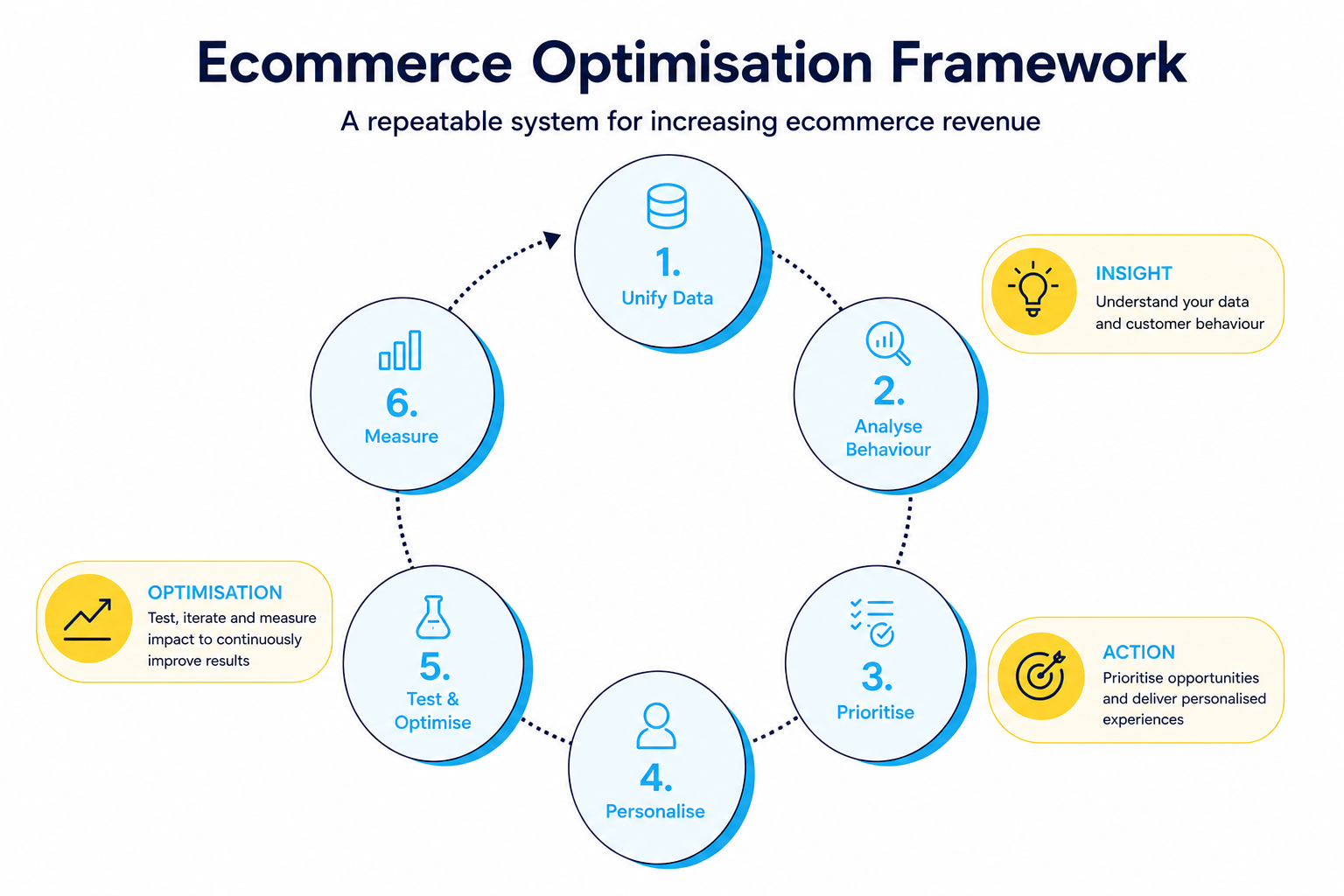
Most ecommerce teams lack a clear process for turning ideas into consistent growth. Optimisation often happens reactively. A drop in performance triggers a fix. A new idea triggers a test.
Without structure, results are inconsistent and difficult to scale.
The Ecommerce Optimisation Framework provides a repeatable process for improving performance across the five core pillars.
You cannot optimise what you cannot see. Start by bringing together data from across your ecommerce platform, email, analytics, and other channels to create a single customer view.
This allows you to:
This step underpins everything that follows.
Once your data is unified, the next step is to find where value is being lost.
Focus on:
This is where optimisation opportunities become visible.
Not all improvements deliver equal results. Focus on changes that will have the biggest impact on revenue, such as:
This ensures effort is directed where it matters most.
Use your data to make interactions more relevant. This includes:
Relevance increases engagement, conversion and retention.
Optimisation is not a one-off project. Test:
Measure the impact and build on what works. Over time, these improvements compound.
Track performance using metrics that link directly to revenue:
Use these insights to refine your approach and identify the next set of opportunities.
Most ecommerce optimisation efforts fail because of how they are approached. These are the most common mistakes that limit performance.
Optimisation is often approached as a campaign or a test.
Run it once, then move on.
In reality, optimisation only works when it is continuous. Small improvements over time are what drive meaningful growth.
When data sits in separate platforms, insight is limited. This leads to:
Without a unified view, personalisation and optimisation stall.
Many brands optimise individual touchpoints but ignore how they connect.
You might improve a product page but lose customers at checkout. Or run strong campaigns that lead to a weak on-site experience.
Optimisation needs to consider the full journey, not isolated steps.
Personalisation often stops at basic segmentation or simple tactics. Using limited data or broad audiences creates the appearance of personalisation, but not real relevance.
Customers expect experiences that reflect their behaviour, not generic messaging.
A large share of ecommerce traffic comes from mobile, yet many sites still create friction on smaller screens. Common issues include:
If the mobile experience is weak, overall conversion will suffer.
High click-through rates can look positive, but clicks do not equal sales.
Optimisation should focus on:
Clicks are a helpful signal, but revenue is the main objective.
Many brands invest heavily in acquiring customers, then do very little to bring them back. Without retention:
Retention is a core part of profitable growth.
Most of these issues come down to the same problem: a lack of structure. Without a clear framework, teams default to:
Ecommerce optimisation only becomes effective when it is approached as a structured, continuous process.
To understand whether your optimisation efforts are working, you need to track the right metrics. Not vanity metrics. Revenue-driving metrics.
Conversion Rate: The percentage of visitors who complete a purchase.
Formula: Conversions ÷ Total visitors × 100
Why: This is the clearest indicator of how effectively your site turns traffic into customers.
Average Order Value (AOV): The average amount spent per order.
Formula: Total revenue ÷ Number of orders
Why: Increasing AOV means more revenue from each customer without increasing traffic.
Customer Lifetime Value (CLV): The total revenue a customer generates over their entire relationship with your brand.
Why: CLV reflects the long-term value of your customers and the impact of retention.
Retention Rate: The percentage of customers who return to make another purchase.
Formula: Returning customers ÷ Total customers × 100
Why: Retention is a key driver of profitability and sustainable growth.
Cart Abandonment Rate: The percentage of customers who add products to their cart but do not complete the purchase.
Formula: 1 − (Completed Purchases ÷ Carts Created)
Why: Highlights friction in the checkout process.
Revenue Per Visitor (RPV): The average revenue generated per visitor.
Formula: Total revenue ÷ Total visitors
Why: Combines conversion rate and order value into a single performance metric.
Email Conversion Rate: The percentage of email recipients who complete a purchase after clicking through.
Why: Shows how effectively your email marketing drives revenue, not just clicks.
Tracking metrics is only useful if it leads to action. Each KPI points to a specific optimisation opportunity:
Use these insights to prioritise where to focus your optimisation efforts.
Ecommerce optimisation is the process of improving your website, marketing, and customer journeys to increase conversion rates, average order value, and customer lifetime value.
You improve ecommerce conversion rates by reducing friction and increasing trust across key touchpoints. This includes:
– Improving product pages with clear information and social proof
– Simplifying the checkout process
– Increasing site speed and usability
– Personalising content and recommendations
A typical ecommerce conversion rate ranges from 2% to 4%, although this varies by industry, product type, and traffic source. The focus should be on improving your own baseline rather than aiming for a fixed benchmark.
Ecommerce CRO (conversion rate optimisation) is the process of increasing the percentage of website visitors who complete a purchase by improving user experience, messaging, and site performance.
The most important ecommerce metrics include:
– Conversion rate
– Average order value (AOV)
– Customer lifetime value (CLV)
– Retention rate
– Revenue per visitor (RPV)
These metrics directly impact revenue and growth.
Personalisation improves ecommerce performance by making content, products, and messaging more relevant to each customer. This leads to:
– Higher engagement
– Increased conversion rates
– More repeat purchases
A customer data platform (CDP) is a system that collects and unifies customer data from multiple sources to create a single customer view. This data can then be used for segmentation, personalisation, and marketing activation.
You increase customer lifetime value by encouraging repeat purchases and building long-term relationships. This includes:
– Post-purchase email journeys
– Personalised product recommendations
– Loyalty and reward programmes
– Re-engagement campaigns
Cart abandonment occurs when a customer adds items to their basket but does not complete the purchase. You can reduce it by:
– Simplifying checkout
– Improving page speed
– Being transparent about delivery costs
– Sending abandoned cart emails
Ecommerce optimisation is important because it increases the revenue generated from existing traffic. Instead of relying on more acquisition, it improves conversion, retention, and overall marketing efficiency.



