A WhatsApp chatbot is an automated conversational solution that enables businesses to interact with customers directly via the WhatsApp messaging platform. Instead of relying solely on human agents, chatbots can instantly respond to inquiries, guide users through journeys, and deliver real-time support within a familiar messaging experience.
As messaging apps become a primary communication channel for many consumers, WhatsApp has emerged as one of the most important platforms for customer interaction. Businesses increasingly use WhatsApp chatbots to automate repetitive conversations, improve response times, and scale their customer communication.
A WhatsApp chatbot is an automated system that communicates with users through the WhatsApp messaging platform. Businesses use WhatsApp chatbots to answer questions, automate customer support, collect leads, and guide users through processes such as booking appointments or tracking orders.
Most WhatsApp chatbots operate through WhatsApp for Business, which allows organisations to automate conversations and integrate messaging with CRM systems, marketing automation tools, and customer service platforms.
Because WhatsApp is one of the most widely used messaging apps worldwide, chatbots on this platform enable businesses to deliver fast and scalable customer communication.
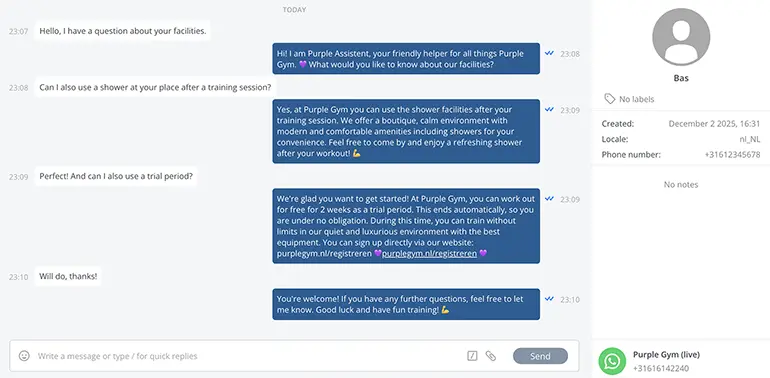
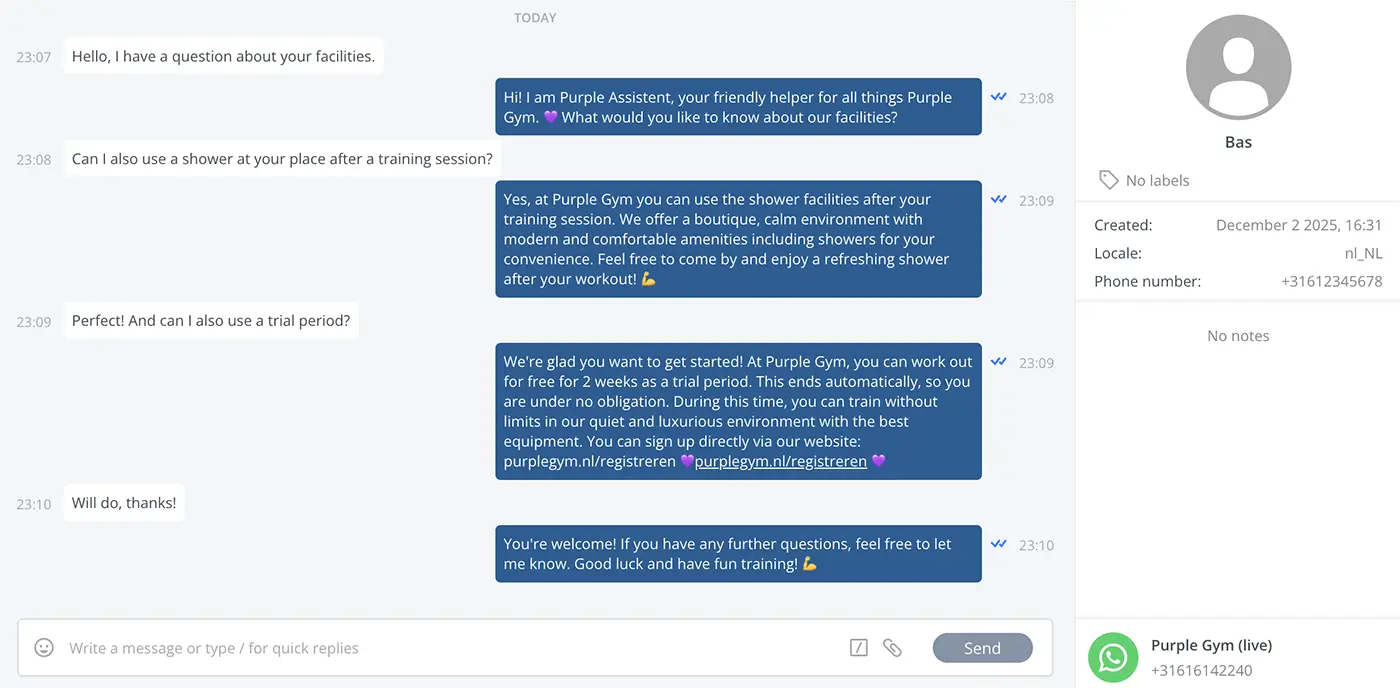
Example of a conversation answered by a bot on WhatsApp
A WhatsApp chatbot processes incoming messages and responds automatically based on predefined rules or artificial intelligence.
Most implementations rely on three key components.
Conversation flows guide users through predefined options. For example, a chatbot may present choices such as:
These structured workflows allow businesses to quickly handle common requests.
More advanced chatbots use artificial intelligence (AI) to understand messages written in natural language. This allows users to type questions freely instead of selecting predefined menu options.
AI-powered chatbots can recognise user intent and respond with relevant information, using a connected knowledge base to retrieve accurate, up-to-date answers tailored to the user’s query.
When a request becomes too complex for automation, the chatbot can transfer the conversation to a human agent. This ensures customers always receive personal support when needed.

Businesses can use different types of chatbots depending on their automation needs.
Rule-based chatbots follow predefined conversation flows. They respond to specific triggers or button selections and guide users through structured workflows.
These chatbots are commonly used for FAQs, appointment scheduling, and basic customer support.
AI chatbots use natural language processing and machine learning to interpret user messages. They can understand different ways of asking questions and provide more flexible responses.
Many companies combine automation with human support. In this model, the chatbot handles routine questions while customer service agents take over more complex interactions.
WhatsApp chatbots are used across many industries and business processes.
Businesses use chatbots for webcare to answer frequently asked questions, provide order updates, and guide customers through troubleshooting steps.
Chatbots can collect contact details, qualify prospects, and help users find the right product or service. Especially in ecommerce, chatbots are more and more used as sales assistants.
Service providers often use WhatsApp chatbots to book appointments, confirm reservations, and send reminders.
Customers can receive shipping updates, delivery confirmations, and account alerts through automated WhatsApp messages.
Companies can engage users with personalised messages, product recommendations, and interactive campaigns inside WhatsApp conversations.

Businesses adopt WhatsApp chatbots for several practical reasons.
A chatbot can respond instantly at any time of day, allowing companies to support customers outside normal business hours.
Automation ensures customers receive immediate answers to common questions.
A single chatbot can manage thousands of conversations simultaneously.
By automating repetitive tasks, customer service teams can focus on complex or high-value interactions.
Messaging platforms often achieve higher engagement rates than traditional communication channels such as email or web forms.
Messaging platforms have become one of the most important communication channels for businesses and customers.
Several statistics illustrate the growing importance of WhatsApp and chatbot automation.
Because of these trends, WhatsApp chatbots have become a key component of modern conversational customer engagement strategies.

For many organisations, WhatsApp chatbots are part of a broader conversational automation strategy.
Instead of treating messaging as a standalone channel, companies integrate WhatsApp with CRM systems, marketing automation platforms, and customer support tools.
For example:
This approach allows businesses to combine automation with personalised customer interactions.
A WhatsApp chatbot is used to automate conversations with customers through the WhatsApp messaging platform. Businesses commonly use chatbots to answer questions, provide support, send updates, qualify leads, and guide users through processes such as booking appointments or tracking orders.
A WhatsApp chatbot processes incoming messages and responds automatically using predefined conversation flows, artificial intelligence, or a combination of both. When necessary, the chatbot can transfer the conversation to a human support agent.
Yes. Businesses can use chatbots on WhatsApp through WhatsApp for Business (integrated in a operating platform such as Spotler), which provides official access to messaging automation and integrations with business systems.
WhatsApp automation refers to any automated messaging process, such as sending notifications or scheduled messages. A WhatsApp chatbot is a specific type of automation that allows interactive conversations with users.
Some WhatsApp chatbots use artificial intelligence and natural language processing to understand messages written in natural language. Others rely on predefined conversation flows.
Yes. Many companies use WhatsApp chatbots to collect contact details, qualify prospects, and guide potential customers toward products or services.
Spotler enables organisations to manage WhatsApp conversations, automate responses, and build chatbot workflows within a single messaging environment.
With Spotler and its WhatsApp integration, businesses can:
This allows teams to combine automation with personal conversations while scaling their messaging strategy.
After having read this article, we can imagine that you want to check for your self if and how a WhatsApp Chatbot can work for your organisation. Could it be beneficial for you? What is the effort for you to make this work for you? And how does it exactly work if you connect a WhatsApp for Business account to Spotler?
Tons of questions to be answered, so an online demo seems like a good idea.
Our experts are here to show you what can be achieved if you fill out the form: