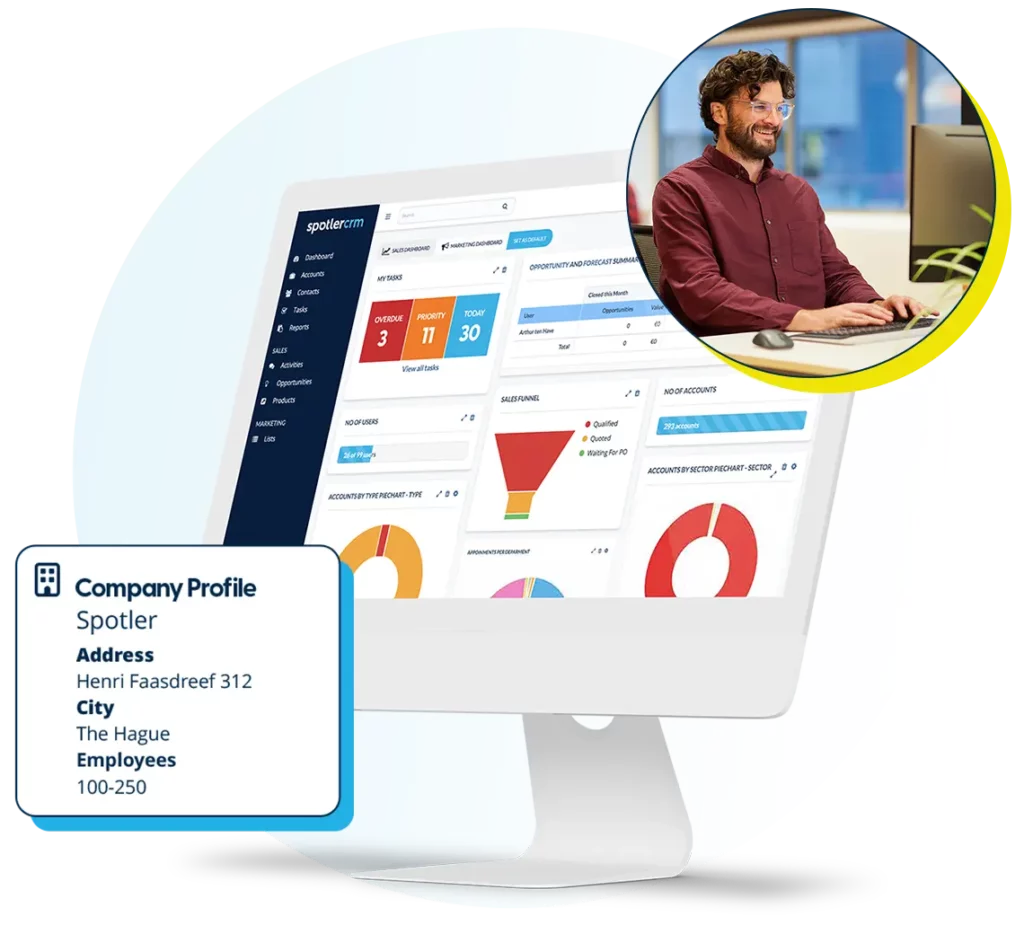
Manage leads, customers, and pipelines in one place. Discover how Spotler CRM brings marketing and sales together for B2B teams.
Many organisations work with fragmented data, manual segmentation, and limited insight into which leads are ready to buy. Leads are stored in spreadsheets, event data sits in separate tools, and follow-up is often inconsistent.
Through integration with Spotler Mail+ and Spotler Leads, Spotler CRM creates a marketing automation platform that allows you to generate, track, nurture, and prepare leads for handover to sales, with all information and digital activity neatly organised per contact and account.
When sales teams store notes in one place, marketing saves leads in other systems, and event data sits in separate tools, a complete picture of the pipeline is missing. Time is lost on manual updates, follow-up after campaigns or events is missed, and communication is inconsistent. It is also difficult to determine which leads are ready for sales.
Spotler CRM brings this together in one central environment for leads, customers, opportunities, and event data. This gives teams a grip on their pipeline and enables structured collaboration.
In combination with Spotler Mail+ and Spotler Leads, a single shared database is created in which marketing and sales work with the same data. This makes behaviour visible, allows leads to be followed up more effectively, and ensures handover to sales takes place at the right moment.
Spotler CRM is designed for small to medium-sized B2B organisations and non-profits that want to manage leads, customers, members, and opportunities without the complexity of traditional CRM systems. The platform is particularly suitable for:
Teams that want structure in pipeline management and customer relationships, and want to gain control over follow-up and conversations.
Teams that organise campaigns and events and want insight into engagement, behaviour, and lead follow-up.
Companies working with multiple tools, spreadsheets, or separate systems that need one central database.
Spotler CRM is also a logical choice for organisations already working with Spotler Mail+ and Spotler Leads that want to bring this data together.
The platform is especially valuable for organisations where marketing and sales collaborate based on shared data and need a complete picture of the customer.

In practice, Spotler CRM adds the most value in organisations where marketing and sales collaborate and large amounts of customer data come together. Examples include:
Organisations with a clearly defined target audience (ICP) and complex sales cycles. Sales records customer information and conversations, while marketing runs campaigns to generate new leads and nurture existing ones. With Spotler CRM, this all comes together: from first website visit to deal in the pipeline.
Think consultants, agencies, and training providers. Here the focus is on relationship management, conversations, and follow-up. CRM provides an overview of customer information, ongoing processes, and tasks, while marketing drives lead generation and nurturing through campaigns and events.
Organisations that need insight into members, prospects, and interactions. From membership to event attendance and communication: everything is managed centrally. Marketing and relationship management work together to recruit, activate, and retain members.
Many organisations work with multiple systems in which customer data is spread across different locations.
Lead and customer data are spread across different systems and teams, meaning there is no complete picture of contacts and companies.
Spotler CRM brings contacts, companies, and all interactions together in one central database. This allows sales and marketing to work with the same information and context.
A complete and consistent picture of every lead and customer, enabling teams to collaborate more effectively and improve follow-up.
Effective segmentation requires insight into behaviour and interactions, not just basic data.
Marketing teams struggle to build relevant segments because data is spread across systems and often limited to basic information.
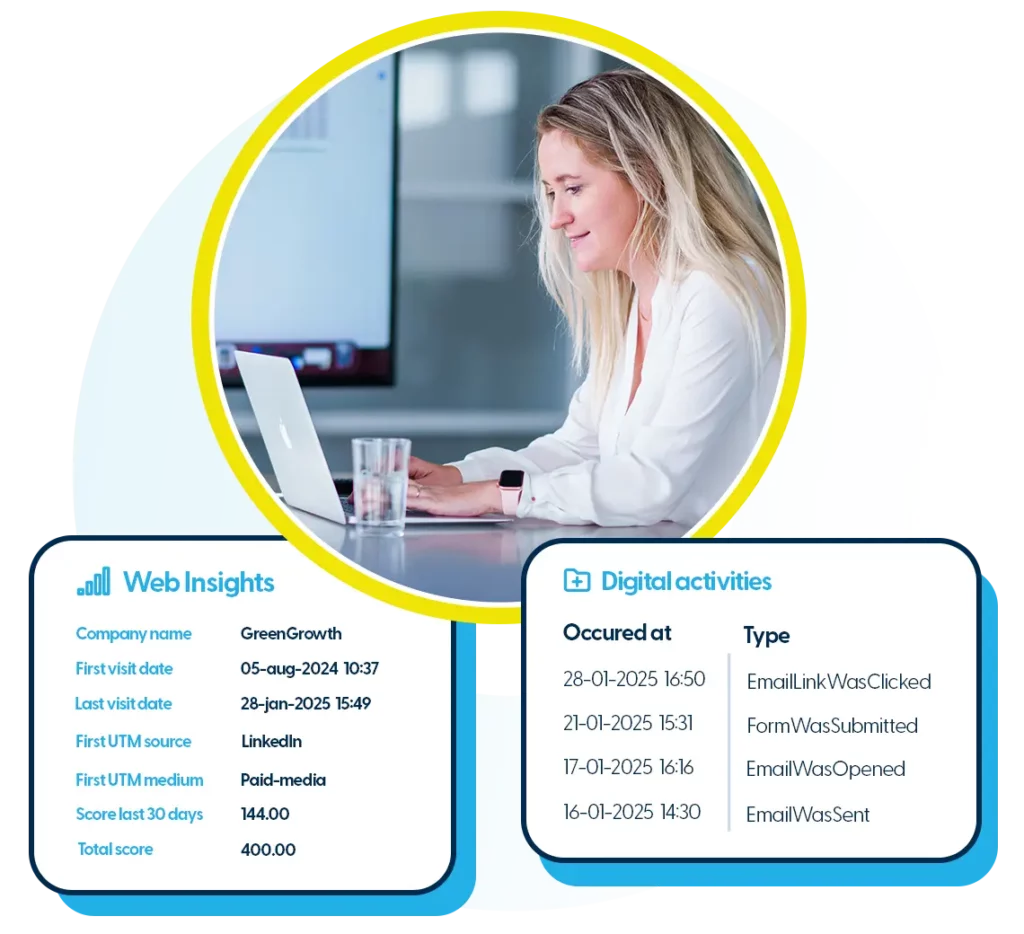
In combination with Spotler Mail+ and Spotler Leads, segments can be built based on behaviour such as website visits, email interactions, and event attendance, supplemented by company and contact details.
More targeted campaigns and segments that better reflect the behaviour and purchase intent of leads and customers.
Not every lead is ready to be followed up by sales.
Sales teams spend time on leads that are not yet ready to convert.
Lead scoring is automatically updated based on behaviour such as website visits and interactions, making intent visible.
Sales can focus on leads with the highest likelihood of conversion.
Without insight, it is difficult to improve marketing and sales performance.
Teams have limited visibility into the pipeline and marketing contribution.
Spotler CRM offers reports on leads, opportunities, and activities.
Greater insight into performance and progress.

Spotler CRM provides the core functionality that B2B teams need to manage relationships, opportunities, and engagement, without unnecessary complexity. Spotler CRM helps organisations to:
Spotler CRM integrates with other Spotler products and systems to bring marketing, sales, and event data together in one central database.
Connect marketing, sales, and events so that teams work with shared data and insight into the complete customer journey.
Combine different data sources to gain better insight into engagement, intent, and follow-up.
Connect CRM with other systems and automate data exchange between tools.

For many B2B teams, the impact of a connected CRM goes beyond structure and efficiency. It determines how quickly teams can act, how consistently they follow up, and how well they understand what drives engagement and revenue.
Organisations using Spotler CRM typically experience:
Spotler CRM brings structure and insight to lead and customer management. In combination with Spotler Mail+ and Spotler Leads, you work from one central database in which behaviour, engagement, and follow-up come together.
A small sales team uses Spotler CRM to manage leads and customers. They log conversations, add notes, and track opportunities through the pipeline. Managers use reports to monitor deal progress and identify stalled opportunities.
Spotler CRM replaces separate spreadsheets and gives the team one shared overview, making follow-up more consistent and ensuring no information is lost.
A marketing team runs ongoing campaigns to generate leads. Email interactions, website visits, and form submissions are automatically recorded in Spotler CRM.
Based on this behaviour, leads are scored and prioritised for sales. Marketing gains insight into which campaigns contribute to new opportunities, while sales works from one complete overview of the lead history.
This results in a targeted and consistent handover from marketing to sales, based on data rather than assumptions.
Looking for a CRM that is easy to use and works seamlessly with your marketing tools? Discover how Spotler CRM fits into your B2B setup and how it works with other Spotler products.
Yes. Spotler CRM works as a standalone CRM for managing leads, customers, and opportunities.
The combination creates a shared database for marketing and sales. This means lead engagement, scoring, and customer data are visible in one place, improving alignment and follow-up.
Yes. Although a CRM is often used by sales, marketing teams benefit from shared insights when CRM is connected to Spotler Mail+ and Spotler Leads.
Yes. Spotler CRM is built to integrate with other Spotler products, with a shared data model to keep information consistent.
You can continue using your existing CRM as a sales system. Spotler CRM can function alongside it as a central marketing database. Marketing teams can independently manage fields, segments, and automations without depending on sales structures or IT. At the same time, alignment with sales is maintained because both teams work with shared data and insights.
The cost of Spotler CRM depends on factors such as the number of users, the desired features, and the combination with other Spotler products. You can get started with Spotler CRM, including five users, from 165 € per month. Take a look at our pricing page for more detailed information suited to your situation.