Email continues to prove its value. But the DMA Email Tracker 2026 makes one thing clear: success is no longer about simply “doing email well”, it’s about doing it smarter, faster, and more connected than ever before.
This report will give marketers insight into the use of both email marketing and AI in conjunction with the multitude of digital channels available to marketers today, explaining the reasons and how to use the channels at your disposal.
From our perspective at Spotler, the findings reinforce what we’re seeing every day within our own customers.
Performance is strong, but expectations are higher
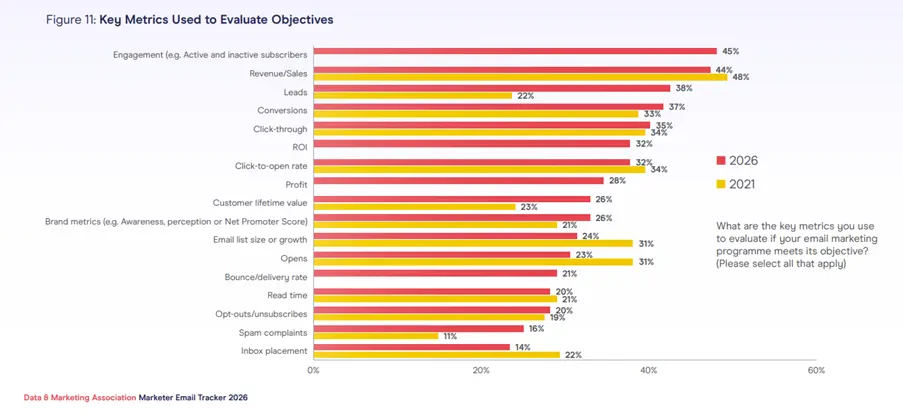
Email remains one of the highest-performing channels for ROI. That’s not new. What has changed is the expectation around performance.
Marketers are now under pressure to:
- Prove ROI more clearly
- Deliver more personalised experiences
- Do it all with less time and resources
Key takeaway: Strong performance alone isn’t enough; it must be measurable, attributable, and scalable. Deliver more relevant emails faster, with all elements working together efficiently and intelligently across the entire customer journey.
Personalisation is no longer a differentiator; it’s the baseline
The report highlights continued investment in personalisation, segmentation and dynamic content. But there’s a shift happening.
Basic personalisation using simple segmentation is now expected.
What drives results is:
- Behavioural triggers
- Real-time data usage
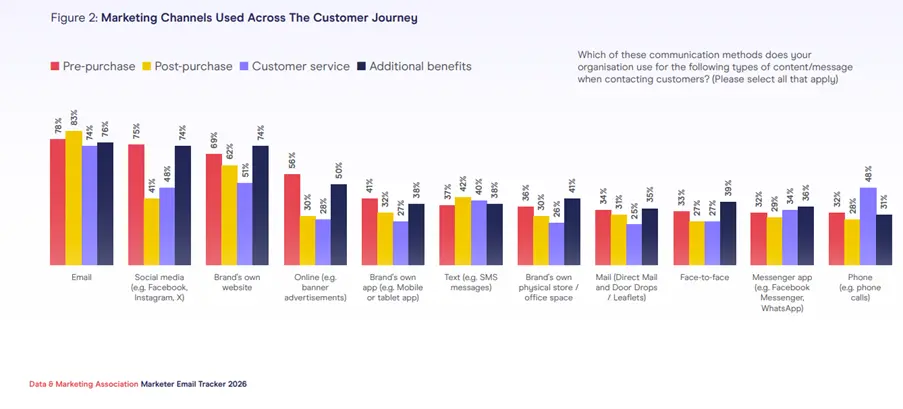
- Cross-channel consistency
This is where connected data becomes critical. Without it, personalisation quickly hits a ceiling.
Data challenges are still holding marketers back
Many marketers face persistent challenges every day that directly affect their time, resources, and effectiveness. Despite advances in martech, they continue to struggle with:
- Disconnected systems
- Inconsistent data
- Limited visibility across the customer journey
This aligns closely with what we hear across the UK market. The opportunity isn’t just better tools; it’s bringing those tools together so marketers can:
- Act on insights faster
- Reduce manual effort
- Create a single customer view
Automation is growing, but maturity varies
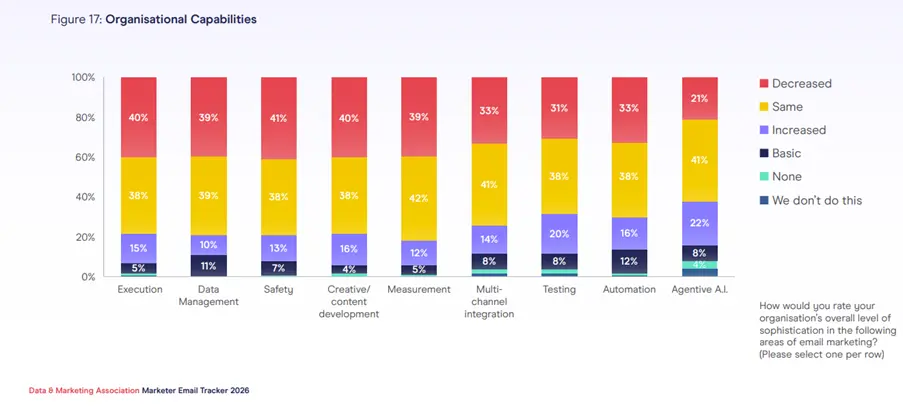
Automation adoption is increasing, but the sophistication gap is wide. Many brands are still focused on welcome journeys and basic lifecycle campaigns. While more advanced use cases, such as:
- Predictive targeting
- AI-driven optimisation
- Omnichannel orchestration
… are still underutilised.
The next step for marketers isn’t more automation; it’s smarter automation that drives measurable outcomes.
Time is the biggest barrier
One of the most telling themes in the report is that marketers know what they should be doing but don’t have the time to do it.
Between reporting, campaign execution, research, and managing multiple tools, time is often lost in the process rather than spent on strategy. This is where technology should step in: not to add complexity, but to remove it. Allowing marketers to connect tools, data and output together into one seamless journey and process.
What this means for marketers in 2026
The DMA report reinforces a clear shift:
- From campaigns to connected customer journeys
- From outputs to outcomes
- From more tools to better use of existing data
At Spotler, we see the biggest impact when marketers can:
- Unify their data
- Automate intelligently
- Prove their impact clearly
Because ultimately, the goal isn’t just to send better emails, it’s to make marketing easier, more effective, and more accountable.
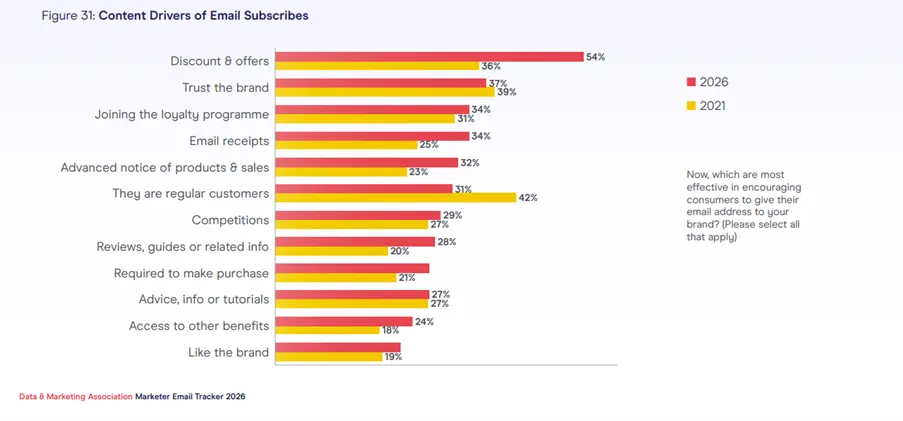
“Discounts now dominate email acquisition: 54% cite them as the most effective subscription driver, up 18 percentage points since 2021. Whilst brand trust has barely moved at 37% versus 39%, and ‘regular customers’ as a motivator has dropped 11 percentage points to 31%.”
Quick Win Actions
If you do nothing else:
- AI is your first reader of your emails. Write your next email with this in mind
- Align every channel with every stage of the customer journey
- Run a welcome series without a discount
- Research your average unsubscribe reasons
- Test your next email using a screen reader before sending
Email remains the most widely used and resilient marketing channel, embedded across the entire customer journey and accounting for a growing share of marketing budgets.
However, while capability has improved significantly, execution, measurement, and strategy have not kept pace with industry change, particularly in the context of AI, privacy, and evolving consumer behaviour.
Final thought
Email isn’t going anywhere. In fact, it’s becoming more important. The email campaigns that will succeed in 2026 are those that use data, automation, and insights to deliver highly relevant, personalised messages. Focusing on quality over quantity rather than simply sending more emails.
The key takeaway here is that while marketers have access to more tools than ever, those tools aren’t working together in a way that delivers real value.
Most teams are operating with fragmented tech stacks. Using separate platforms for email, CRM, analytics, social, and automation. Because these systems don’t naturally connect, data sits in silos. That creates a few critical challenges:
No single customer view
Marketers can’t see a complete picture of their audience. Behaviour, preferences, and interactions are split across platforms, making it difficult to truly understand customers.
Manual work slows everything down
Teams spend hours pulling reports, exporting/importing data, and piecing together insights. This reduces time spent on strategy and optimisation.
Inconsistent messaging
Without connected data, campaigns can feel disjointed. Customers might receive irrelevant or repetitive emails because systems aren’t sharing updates in real time.
AI and personalisation fall short
AI is only as good as the data it has access to. If data is incomplete or disconnected, AI can’t accurately predict behaviour or personalise journeys. Instead of meaningful one-to-one experiences, you end up with generic messaging.
Missed revenue opportunities
Without joined-up insights, it’s harder to trigger the right message at the right time. Whether that’s an abandoned browse, repeat purchase prompt, or lifecycle campaign.
In short, the challenge isn’t a lack of technology; it’s the lack of connection between technologies. Until data flows seamlessly across tools, marketers will struggle to unlock the full potential of AI, automation, and personalisation.