





We’re all familiar with email marketing, Google Ads, or those indistinguishable sponsored posts on LinkedIn. But a ‘new’ player has entered the marketing multiverse. WhatsApp has been cautiously introduced to modern marketers as a new way to send newsletters. But when we look at its potential in automations, we find that WhatsApp is much more than just a shortened version of your monthly company recap.
I’d like to dive into 5 WhatsApp marketing campaigns you can set up. Not the ‘upload a list and start sending’ type of campaigns, but the ‘use real-time data and persuade your audience’ type of campaigns.
A Customer Data Platform (or: CDP) is a piece of software running on your (eCommerce) website. It collects data on the people visiting your pages, defines their interests, and can translate that to smart website personalisations. Think pop-ups, different visuals, or ‘next best offers’. In this blog, we’re also showing how to set up some of the example campaigns in our CDP, Spotler Activate. You will find those tips highlighted in green.
Why combine a Customer Data Platform with WhatsApp?
With a Customer Data Platform in place, you take control of what your website visitors see. But it doesn’t stop there exactly. It also allows you to orchestrate what happens next.
Imagine I am on your website. You’re selling football jerseys. Match made in heaven already. Now, I keep returning to a certain club’s jerseys, but I am not making any purchase. It makes sense that you want to convince me to buy merchandise from this club. Next time, you should personalise the homepage so it shows someone posing in their jersey.
Return to the website
But if I don’t return to your website, you still want me to return and make the purchase. In this case, a CDP opens a door to many marketing opportunities. In this case, you have my profile data: name, email, and phone. Traditionally, you would email me with an abandoned cart email or send me a newsletter with new products dropped by my favourite brand.
However, like many people, I don’t have my email notifications turned on. I do have my WhatsApp notifications light up my screen. Now, we have the perfect combination. My interest may be gone from your website, but my phone buzzing got my attention right back to you.

To regain that attention, interest, and maybe even desire, here are five example campaigns you could practically implement tomorrow if you have a Customer Data Platform & WhatsApp messaging platform:
- Abandoned shopping carts
- Back-in-stock products
- Re-engaging old customers
- Post-purchase upsell
- Welcome journey
Abandoned Cart campaign via WhatsApp
Cart abandonment is one of eCommerce’s biggest (and most fixable) revenue leaks. A well-timed WhatsApp message can nudge high-intent shoppers to complete their purchase. Especially when the message is personal, well-timed, and adds value.
The trick isn’t to just send a reminder. Not a ‘Hey Tom, you left this in your cart’. Make the reminder feel useful or compelling. Two quick tips to make the most of this campaign, whether you’re selling shoes, supplements, or sofas:
1. Time it to match your buyer’s behaviour
Short cycle products? Send within 1 or 2 hours. These types of buyers often make quicker decisions. On the other hand, be gentler with high-consideration products: a nudge after 12 to 24 hours can be more effective, especially with social proof or reviews. My advice: Test different send times. Spotler Activate lets you run split tests on delays.
2. Add value beyond “You forgot something”
I know your messages are automated, but they don’t have to feel automated. As someone torn between being a millennial and Gen Z, I often buy on vibes. Cialdini would approve if you add scarcity, social proof, or reciprocity to the mix.
Examples of abandoned cart WhatsApp messages
The product is limitedly available
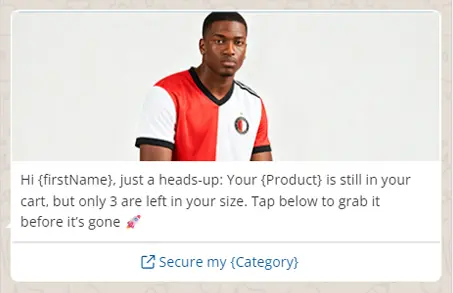
“Hi {firstName}, just a heads-up: Your {Product} is still in your cart, but only 3 are left in your size. Tap below to grab it before it’s gone 🚀”
Others also purchased…
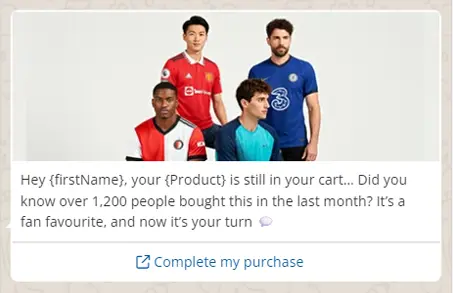
Hey {firstName}, your {Product} is still in your cart…Did you know over 1,200 people bought this in the last month? It’s a fan favourite, and now it’s your turn 💬
You give, you get
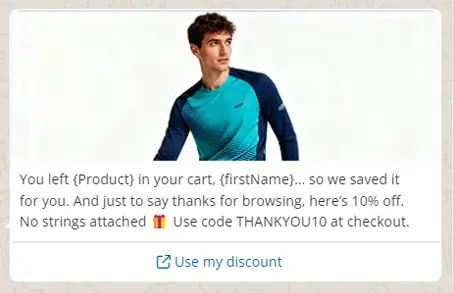
You left {Product} in your cart, {firstName}… so we saved it for you. And just to say thanks for browsing, here’s 10% off. No strings attached 🎁 Use code THANKYOU10 at checkout.
Back in Stock campaign
Out-of-stock pages can be conversion killers, but have potential if you know how to use its data. If someone tried to buy a product and it wasn’t available, they’ve practically raised their hand to say, “I want this”. All you need to do is show up when it’s back. Again, two quick tips for you:
1. Let the product do the talking
People don’t want to miss out again. Highlight what’s back. Name, image, best feature. Let the product shine. If your stock is low, say so. If it’s a popular item, say that too.
Use Spotler Activate to track who viewed or tried to buy an out-of-stock product. You’ve got the perfect audience. Learn how
2. Add a nudge, not a shove
Back-in-stock messages are inherently helpful. But helpful can still be persuasive. Think: limited quantities, free shipping, wishlist vibes. Make the message feel like a VIP tip-off, not a pushy promo.
Reminder: If someone’s opted into WhatsApp, they’re already engaged. Treat them like an insider, not just another window shopper.
Examples of back-in-stock WhatsApp messages
For the sake of product diversity, we’re now selling a lip gloss.
It’s finally back!
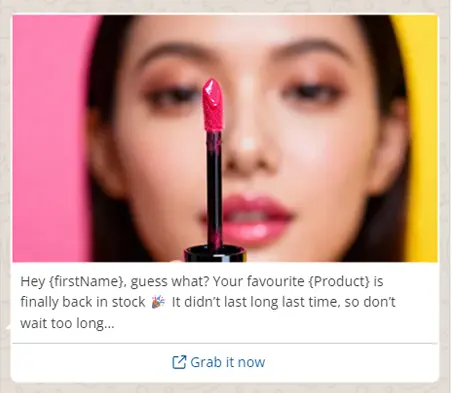
“Hey {firstName}, guess what? Your favourite {Product} is finally back in stock 🎉 It didn’t last long last time, so don’t wait too long…”
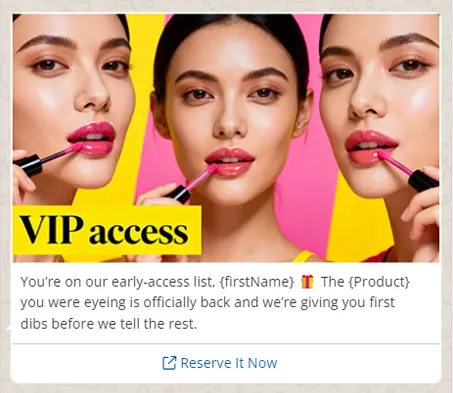
VIP early access
“You’re on our early-access list, {firstName} 🎁. The {Product} you were eyeing is officially back, and we’re giving you first dibs before we share it with the rest.”
Ensure your product feed and inventory data remain in sync with your CDP, so messages are only sent out when items are actually back in stock. No one wants to click through to “out of stock” twice. That’s how you lose trust (and conversions).
A WhatsApp re-engagement campaign
Every ecommerce brand has them: customers who used to buy, but haven’t in weeks… or months. The good news: if they bought once, they’re more likely to buy again than someone brand new.
How? With the right message, timing, and tone. WhatsApp now becomes your friendly nudge, not a guilt trip. You’re reminding them what they liked about you in the first place. The easiest option, of course, is to throw in a discount for everyone. But not everyone needs this to be convinced.
Use Spotler Activate to create a “lapsed” segment based on last purchase date (30, 60, or 90+ days) and layer in value-based filters if you want to prioritise high-LTV customers.
Avoid “we noticed you haven’t bought anything”. Instead, use language that’s warm, familiar, and centred on the customer: their taste, their past purchases, their vibe. Let the emotion or exclusivity carry the message, and use the offer as a reward for coming back, not a bribe.
Now that we’re on the topic of LTV segmenting, here are a few data points to experiment with:
- Category last purchased: show similar items
- Spend level: higher-value offers for VIPs
- Last engagement channel: send WhatsApp only if they’ve responded before
- Last reason for churn: tailor message tone accordingly
Post-purchase upsell via WhatsApp
The moment after a customer makes a purchase is the best time for your next conversion. Why? Because they’re already in the buying spirit. Their trust is high, they’re still engaged, and they’re more likely to act again, especially if the next step feels like a natural extension of what they just bought.
With WhatsApp, you can follow up fast with a product pairing that feels less like a sales pitch and more like a great tip. There are a few ways to make your post-purchase upsell feel smooth (not pushy). We’re highlighting two.
Make the upsell feel like you’re doing them a favour. The easiest way to push someone away is by focusing on the sale rather than the benefit. A good post-purchase message doesn’t say “buy more”. It says, “Here’s what goes perfectly with what you just bought”.
Use Spotler Activate to trigger recommendations based on the “Purchase” event, and layer in “Product Category = X” to suggest matching accessories, bundles, or replenishment items.
Another great way to use WhatsApp as a post-purchase channel is when you match the timing with the product type. For accessories or bundles? Send the message 30 minutes to 2 hours after checkout. For replenishable items? Send a reminder when you estimate they’re running low. For complex items? Wait a day or two, then suggest supporting products (e.g. care kits, add-ons, how-to content).
Bonus: add video or image carousels for richer storytelling if your WhatsApp template allows.
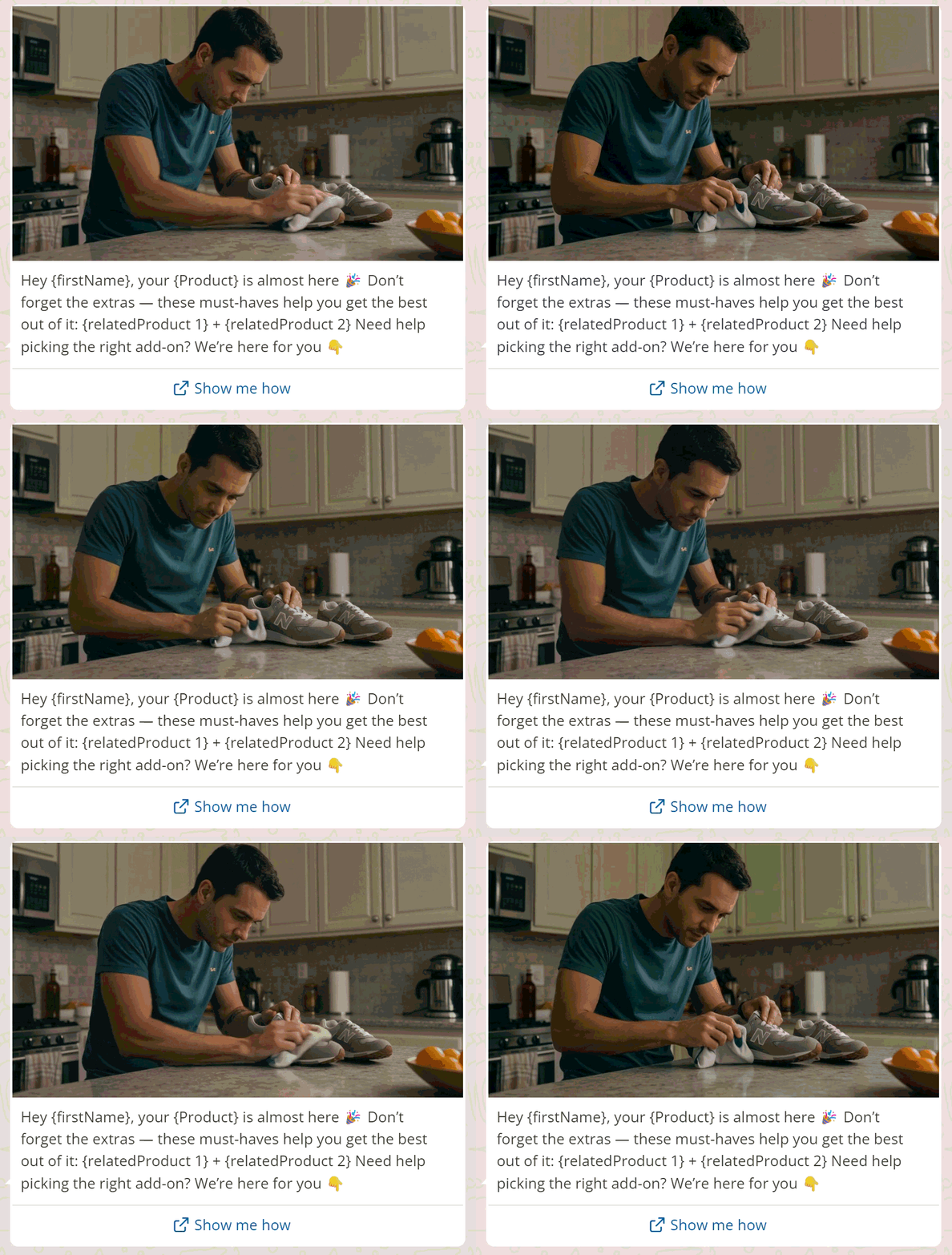
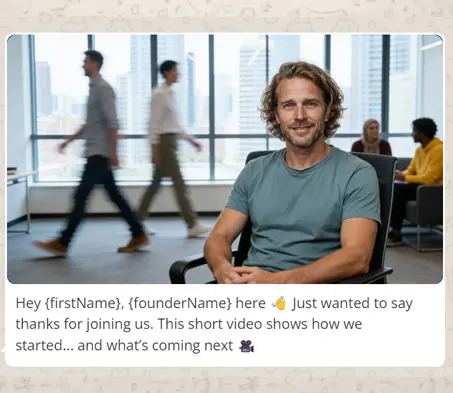
A welcome series in WhatsApp shape
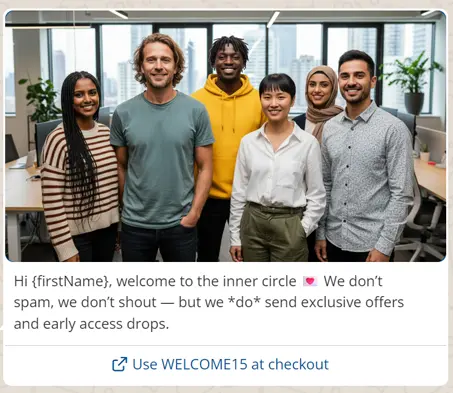
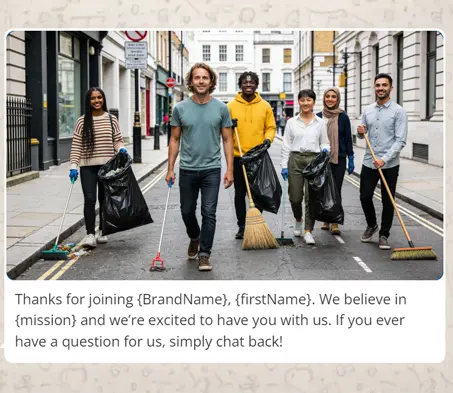
At last, the first message you should send after signing up for your service or buying your products: the welcome message/series. A welcoming message sets expectations. It shapes perception. And it decides whether someone stays curious or forgets you within five minutes.
Too many welcome messages jump straight to the discount. But before you sell, you have a rare chance to stand out, set your tone, and give people a reason to remember (and like) you. WhatsApp is a personal space. So make your welcome feel more like a message from a friend than a formal brand newsletter. Add warmth, add value, and, if it fits, add a little humour or humanity.
You have the data, now start messaging
WhatsApp might have entered your marketing stack as “just another channel”, but as you’ve seen, it’s much more than that. When paired with the real-time data and segmentation capabilities of a Customer Data Platform, WhatsApp becomes a proactive and personalised tool for driving revenue growth.
The five campaigns we’ve covered are practical, proven, and ready to launch with tools like Spotler Activate and Spotler Message. Ready to get started? We’re happy to show you how!
