





Your journeys might work perfectly on paper, but your customers don’t experience them one at a time. You open your marketing automation platform and everything looks great. Maybe even better than great.
- Your welcome journey is running
- Your abandoned basket emails are triggering
- Your post-purchase journey is doing its thing
- Reactivation is ticking away in the background
- SMS messages are being sent when they should be
- You’ve tested the individual emails
- You’ve checked the timings and conditions
- Customers are entering and leaving the journeys exactly as expected
It all looks like the work of an email marketing legend! Now open your inbox.
You signed up this morning and received your first welcome email. An hour later, the regular Tuesday campaign arrived. You clicked through to look at a product, which triggered another journey. Then came the SMS. Meanwhile, your welcome journey is still happily working through its scheduled messages.
Every automation is working exactly as intended but the customer experience isn’t. And that’s the problem with testing automated journeys in isolation.
We tend to look at each workflow individually because that’s how they’re presented to us in our marketing platforms.
But your customer doesn’t know they’re in your welcome journey, your abandonment journey or your latest carefully constructed lifecycle programme.
As far as they’re concerned, it’s all just you.
And if those journeys haven’t been tested together for a while, what looks beautifully organised in the backend can feel very different when it starts landing in a person’s inbox.

Your customer doesn’t know they’re in a journey
As marketers, we give everything a name. The welcome journey. The abandoned basket campaign The post-purchase follow-up. The reactivation journey. The weekly newsletter campaign.
It helps us organise everything in our marketing automation platform, but your customer has no idea which journey they’re in. More importantly, they don’t care. They just see your brand in their inbox.
We naturally test our automations in the same way we build them: one at a time:
- We enter the welcome journey
- Check that email one arrives
- Wait for email two
- Follow the different branches and make sure the right things happen
Everything works, so we switch it on and move to the next job.
Then we build another journey and test that one in isolation too. The problem starts when the same person qualifies for several of them.
Your welcome journey doesn’t know that Tuesday morning is also when your big promotional campaign goes out unless you’ve told it.
Your abandoned basket automation doesn’t necessarily care that somebody received three other emails from you yesterday. And your SMS journey will quite happily join in too.
Each individual journey can therefore pass every test you’ve given it while the combined customer experience fails spectacularly. This is why I think we need to change the question we’re asking when we test automation.
Don’t just ask, “Did the journey work?” Ask, “What else did this customer receive while it was working?”
That’s the view you don’t always get from the beautiful workflow on the screen. And it’s where some of the most annoying automation mistakes begin.

When your welcome journey meets your campaign calendar
Welcome journeys usually get a lot of attention when they’re built. And rightly so.
Someone has just asked to hear from you, so those first few emails are your chance to introduce the brand, set expectations and start the relationship well.
A seasoned CRM manager is probably thinking: “All well and good, Andy, but we exclude anyone in the welcome journey from campaign emails.”
Quite right. Most mature welcome journeys will already have that kind of protection in place.
But those protections can get forgotten as your lifecycle programme grows.
I experienced this recently after signing up to a retailer. Over four days, my inbox filled with welcome-style emails introducing products and offers alongside what appeared to be regular promotional campaigns. Looking at each email individually, there was nothing particularly unusual about them. Looking at my inbox as a whole was a very different experience.
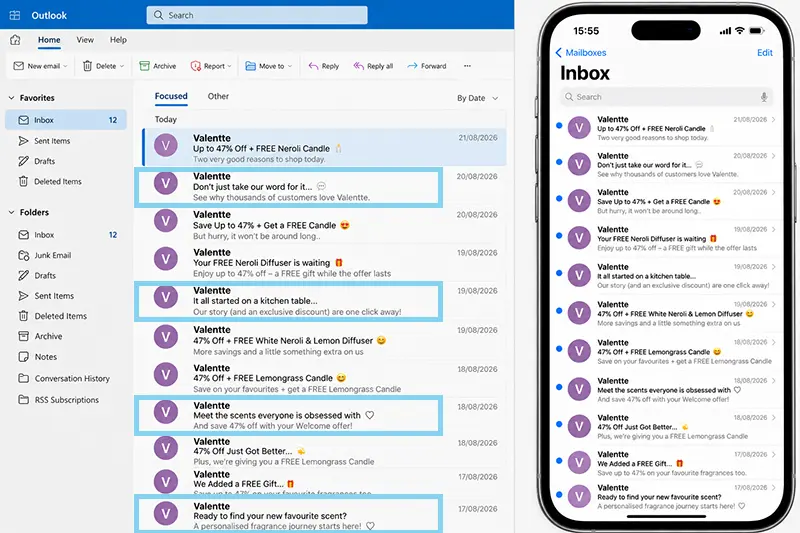
And that’s the problem. You add abandonment, post-purchase, reactivation, browse behaviour, SMS and new campaign types over time. Each gets built and tested, but it’s easy to forget how the latest addition interacts with rules and exclusions created months or years earlier.
“The more sophisticated your lifecycle marketing becomes, the more important it is to test the gaps between the journeys.“
So don’t just check whether Welcome Email 2 arrives when expected. Sign up with a real address, leave it running alongside your normal campaigns and start behaving like a customer.
Browse. Abandon. Buy.
That’s when you find out whether your beautifully organised journeys are quite so beautiful in the inbox.

When every journey thinks it’s the most important
As your lifecycle programme grows, customers will inevitably qualify for more than one journey at the same time.
Someone could be halfway through a welcome journey when they browse a product. They might then abandon a basket, make a purchase or suddenly show much stronger buying intent.
At that point, which journey wins? Hopefully, you’ve already decided.
If not, your automation platform isn’t going to sit there thoughtfully considering which message would be most useful. It’ll follow the rules you’ve given it.
That might mean the customer continues receiving a fairly generic nurture email while a much stronger behavioural signal is ignored. Or worse, everything fires.
This is where journeys need an order of priority:
- A basket abandonment might take precedence over browse abandonment
- A purchase should probably stop several sales-focused journeys altogether
“Your exact hierarchy will depend on your business, but not every trigger deserves equal access to the customer’s inbox.“
And this is another area where mature automation programmes can catch you out. Your priority rules may have made perfect sense when you had four journeys. Now you’ve got twelve.
Testing each one individually won’t show you the problem. Qualifying for several of them at once might.

Your marketing has forgotten I’m already a customer
A purchase should be one of the clearest signals you can give a marketing automation platform. I’ve bought the thing.
Imagine I’ve just treated myself to another expensive Rab hiking jacket, (my guilty pleasure). I receive the order confirmation, followed by a lovely post-purchase journey. Thanks for buying. Great choice. Here’s how to look after your jacket. Let us know what you think.
We’re getting on brilliantly. Then the next day: “You were looking at jackets recently. Still interested?“
Yes. Very interested. So interested, in fact, that I bought one from you yesterday.
This disconnect happens surprisingly often. One journey knows exactly what I’ve done and is treating me like a new customer, while another still thinks I’m a prospect who needs convincing.
From the customer’s perspective, the brand suddenly has a very short memory.
A purchase should change the conversation. It should remove or suppress people from journeys that no longer make sense, influence the campaigns they’re eligible for and, where appropriate, give them a little breathing room from promotional messages about what they’ve just bought.
“This is why placing a real order is such a useful test. Don’t stop when the confirmation email arrives or when the customer successfully enters your post-purchase journey.
Keep watching your inbox. You might be surprised how quickly your marketing forgets you’re already a customer.”
Imagine the same thing happening in a shop. On Monday, the assistant helps you choose your expensive hiking jacket, takes your money and tells you what a great choice you’ve made.
You go back on Tuesday, wearing said jacket maybe looking to buy some reproofer, and the same assistant says: “I noticed you were looking at jackets. Can I interest you in one?” It would be met by a puzzled look!
And don’t assume that returning to a product page means I’m shopping again.
I do this quite often after buying something, particularly with more technical products. I might want to check a specification, confirm the exact model or colour I’ve bought, or look something up now that I have the product in my hands.
Your browse automation sees another product view and thinks buying signal. Your order history provides the context that says recent customer.
That’s why behavioural data needs context. A click, browse or product view tells you what somebody did. It doesn’t always tell you why they did it.
That’s what disconnected automation can feel like. Every conversation makes sense on its own but put them together and the brand suddenly seems to have a very short memory.
Good lifecycle marketing should make customers feel increasingly recognised as the relationship develops.

Your timing works perfectly. For the automation.
Post-purchase journeys are another great example of something that can look completely logical on screen.
Purchase → wait seven days → request a review.
Perfect. Seven days sounds reasonable.
Except I ordered my new coffee machine on Saturday. It wasn’t delivered until Thursday. I didn’t set it up until Sunday night and I’ve made about two coffees with it.
Then your review request arrives. “How are you enjoying your new coffee machine?”
Give me more time guys. I’m still working out what half the buttons do.
This is where journey timing needs to reflect the real customer experience, not simply the date an event entered your platform.
Delivery times matter. So does the type of product or service you’ve sold. Someone might be able to form an opinion about a takeaway within an hour. A coffee machine, software platform or pair of hiking boots needs a little longer.
And it’s not just review requests. The same problem can appear throughout a mature lifecycle programme when delays were chosen months ago and never revisited.
Your business changes, fulfilment changes and customer behaviour changes, while the automation continues waiting its configured seven days.
Again, nothing is technically broken. The email arrived exactly when you told it to. You just told it to arrive at the wrong time.
The rule that nobody remembers adding to the workflow
Automations have a habit of collecting more and more rules over time.
Someone adds a condition, restriction or delay for a perfectly good reason. The journey changes six months later, but that original rules remains in the background.
I recently found a good example on my own phone. I’d opted into SMS messages from a brand and received: “We’re now on SMS!”
Fair enough. Then I received it again. And again. At some point, I think we can safely say I’ve got the message.
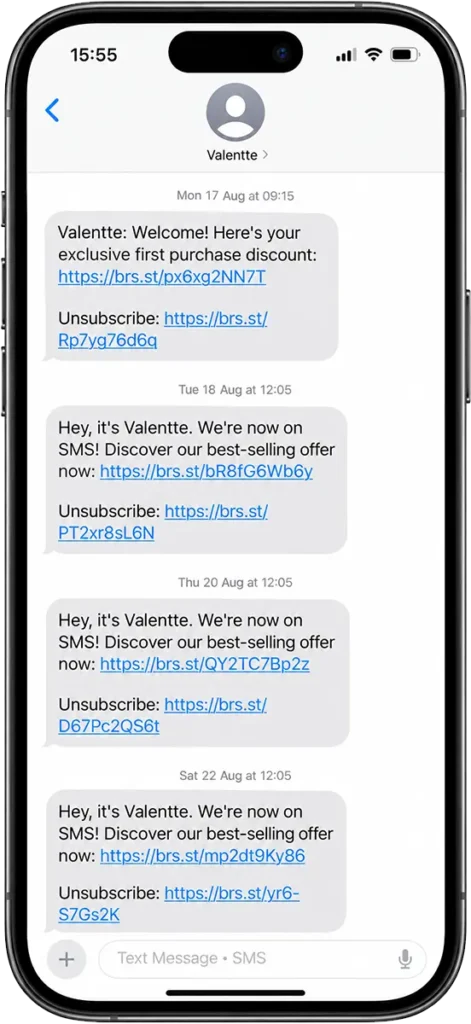
The individual SMS wasn’t the problem. It was clearly intended as a one-off introduction, but somewhere in the segmentation or journey logic it had become something I could repeatedly qualify for.
These are exactly the problems you’re unlikely to spot by looking at a workflow you’ve seen a hundred times. Everything looks familiar and therefore everything looks right.
Sometimes you need to experience the journey yourself again to discover what your customers have been experiencing for months.

How often should you test your automated journeys?
There isn’t a single testing schedule that will work for every business. A journey sending thousands of messages a week deserves more attention than one triggered twice a month.
But “we tested it when we built it” definitely isn’t a testing schedule. Here’s a sensible starting point:
| When | What to check |
| When a new journey goes live | Test every route through the journey, then test it alongside your existing campaigns and automations. Check triggers, exclusions, delays, frequency rules and exit conditions. |
| After the first few weeks | Look at real customers who have completed the journey. What else did they receive while they were in it? Check for collisions you didn’t see during testing. |
| Every 3 months | Become a customer again. Sign up, browse, abandon, purchase and trigger the journeys yourself. Experience everything from the inbox and phone, not the workflow builder. |
| When you add or change another journey | Check what the new or amended journey overlaps with. Review priorities, suppressions and what happens when somebody qualifies for both. |
| When campaign frequency changes | Check whether lifecycle messages are now landing too close to scheduled campaigns. |
| When your data or integrations change | Retest triggers, exclusions and exit conditions. Make sure purchases, browsing behaviour, consent and other important signals are still reaching the right places. |
| When fulfilment or the customer experience changes | Revisit your timings. Delivery taking longer? Product changed? New onboarding process? Your seven-day review request might not make sense anymore. |
| After a customer complaint or strange example | Don’t treat it as a one-off until you’ve checked. Recreate the customer’s journey and find out what combination of rules allowed it to happen. |

Stop testing your workflows. Test the experience
The best way to find these problems is surprisingly simple. Become your own customer.
Use an email address and mobile number you check. Sign up. Browse products. Abandon something. Place an order. Go back and look at something you’ve already bought. Ignore a few emails. Click others.
Stop watching the workflows. Watch your inbox instead.
Look at what arrives, when it arrives and what else you’ve received around it. Read the messages in the order a customer would, rather than jumping between individual journeys in your marketing automation platform.
And don’t only do this when you launch a new journey. Put a reminder in the calendar and repeat it every few months.
Your campaigns, data, products and automations will keep changing, so something that worked perfectly six months ago might produce a very different experience today.
“Then ask yourself one simple question: If I didn’t work for this company, would I be happy receiving all of this?”
Your workflow testing can tell you whether the automation works.
Only living the journey tells you whether the experience does.
