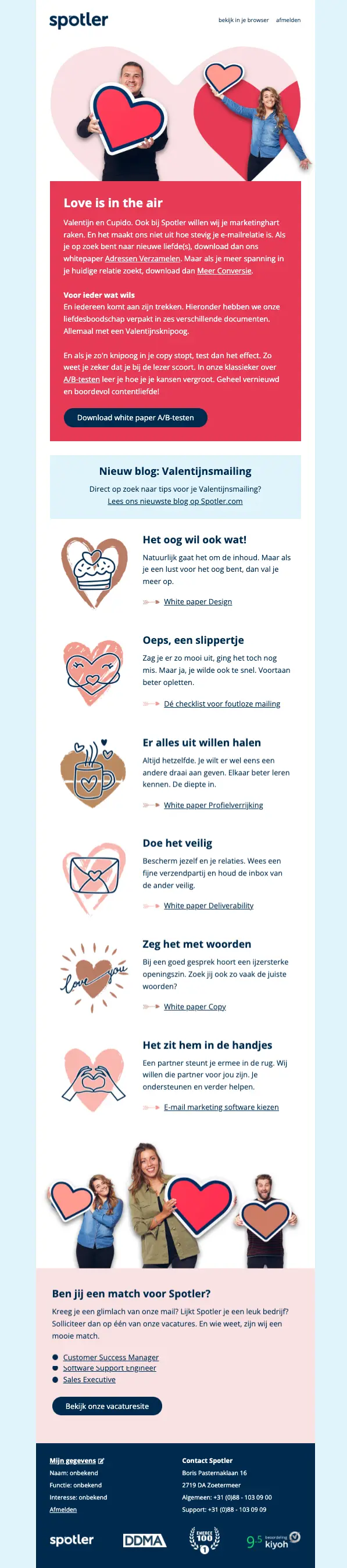
About relationships, relevance and timing
Valentine’s Day has been a fixed moment on marketers’ calendars for years. But where the day used to revolve around one clear message about romance, couples and gifts, that simplicity has disappeared. Fewer and fewer people experience Valentine’s Day in the same way, and that is exactly where the challenge lies for brands.
Because anyone who still rolls out one generic Valentine’s campaign today runs the risk of missing a large part of their audience. Not because Valentine’s Day has become less important, but because its meaning has broadened.
In this blog, we explain what is changing in the way people experience Valentine’s Day, why this has direct consequences for your marketing, and how you can set up your campaigns more intelligently.
Valentine’s Day is no longer one-size-fits-all
Where Valentine’s Day used to be mainly about “buy this for your partner”, we now see a much broader interpretation. Friendship gets a stage through Galentine’s and Palentine’s Day, self-love has become fully normalised, Valentine’s Day is used in B2B to strengthen relationships, and pets are increasingly included as well.
The day is widely recognised and celebrated, but clearly not everyone fills it in the same way. In Finland, for example, 14 February is known as Ystävänpäivä, or Friendship Day. People send cards and small gifts to friends, family and other loved ones, not exclusively to a partner.
In short, Valentine’s Day no longer has a fixed format. And that is exactly what makes it interesting for marketers.
Why this matters for your marketing
For marketers, this shift means Valentine’s Day is no longer a single-use case for romantic offers and last-minute discounts. It is a moment when people are open to attention and appreciation, but only if the message fits their context.
If you ignore that, a campaign will quickly feel generic, predictable or even irrelevant.
Valentine’s Day today requires a broader approach, one that takes into account who you are addressing and what Valentine’s Day means to them, relevance over romance because attention is not dependent on relationship status, and contextual content that shows you understand that Valentine’s Day does not feel the same for everyone.
Brands that take this nuance into account avoid campaigns that get stuck in clichés and instead increase the chance of genuine engagement.
Four ways to get more love out of Valentine’s Day
1. Make your campaign look recognisable and human
Valentine’s Day is an emotional moment, but that does not mean you automatically need to fall back on an overload of hearts and pink gradients. A recognisable visual style with consistent colours, typography and imagery creates cohesion without becoming overly sweet.
Work, for example, with one overarching design, variations per target group, and subtle visuals or emojis that actually add value.
With the template editor in Spotler Mail+, you can work from a single recognisable base design and easily personalise it for each target group. This keeps your campaign consistent while still making the content feel personal.
2. Build your campaign in phases
Sending everything at once on 14 February is a missed opportunity. Not only because many brands do this, but also because relevance needs time.
By starting earlier, you guide your audience step by step towards Valentine’s Day. Think of inspiration emails at the beginning of February, activating content as Valentine’s Day approaches, segment-specific reminders, and a final message with a light sense of urgency.
With campaign flows in Spotler Mail+, you can set up and automate these phases in advance, ensuring each recipient receives the right message at the right moment.
3. Segment by target group instead of using one message for everyone
Not everyone expects the same message around Valentine’s Day. That is why one general campaign is becoming less effective. By segmenting by target group, you can better align with the context and the relationship someone has with your brand.
Singles
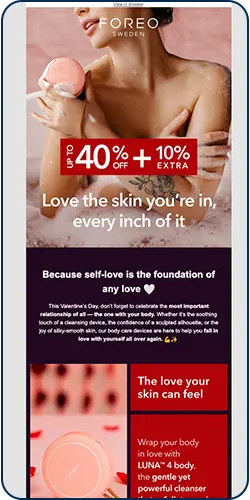
For this group, Valentine’s Day does not need to be a romantic moment. Content with a light tone, humour or a focus on self-care often works better than classic Valentine’s messaging. Think of messages such as “make it your day” or “love starts with yourself”.
Friends and family
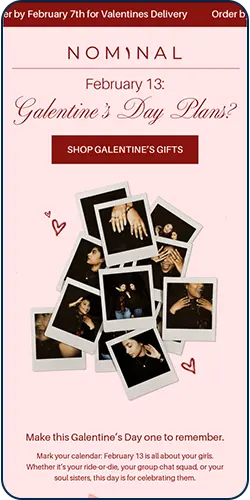
For this group, Valentine’s Day is more about attention and appreciation than romance. Think of friendship, family bonds and small gestures that show you are thinking of someone. Campaigns around Galentine’s Day fit well here, for example, with a light-hearted email focused on friendship. Messages such as “who deserves a little extra attention today?” or “sometimes a small gesture says enough” work well.
B2B relationships and customers
In a business context, Valentine’s Day is a moment to strengthen relationships. There is no sales pressure, but genuine attention and appreciation. Think of a personal thank you email with messages such as “thank you for the trust” or “great to work together”. Or offer something genuinely useful, simply because it is Valentine’s Day.
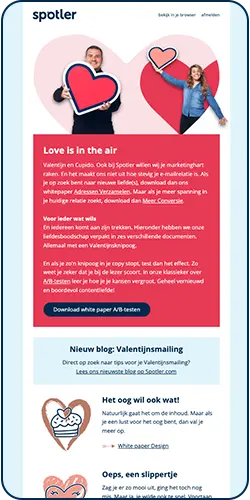
Pet owners
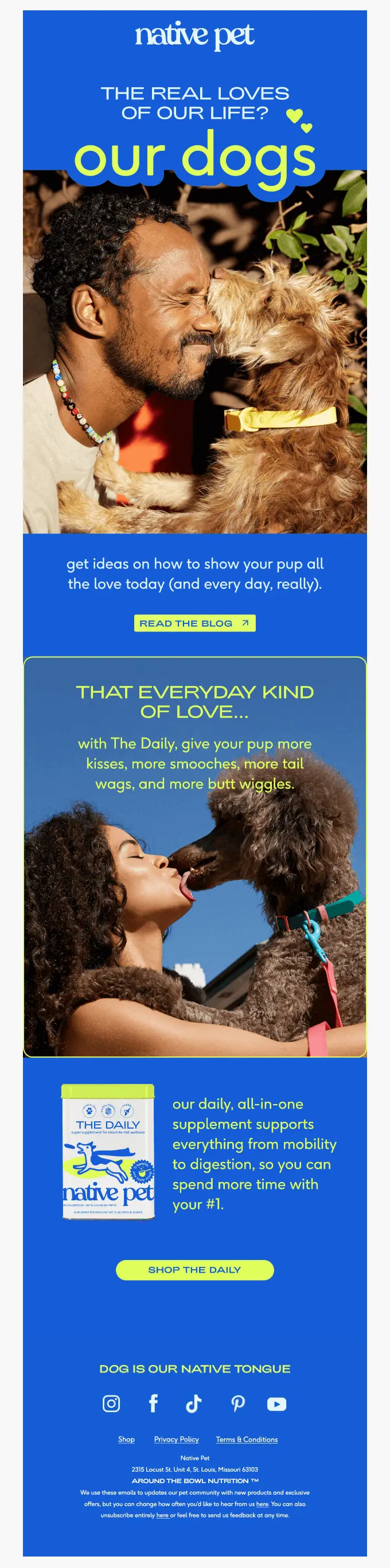
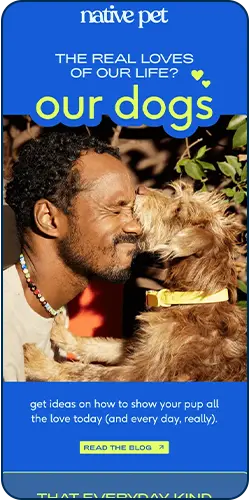
Content that makes Valentine’s Day personal and recognisable works well by highlighting the bond with their pet as a full member of the family. Think of a Valentine’s message where the pet plays a central role, with attention to care, treat moments and daily routines. Messages such as “the real loves of our life, our dogs” or “who is always happy when you come home?” fit perfectly.
Couples
If you want to focus explicitly on couples, choose originality on purpose. Because romantic clichés are so predictable, campaigns that use humour, self-awareness or an unexpected angle stand out more. Think of messages like “I only have fries for you” or “love doesn’t have to be perfect to be real”.

With segmentation and dynamic content, you can apply these differences without having to build a separate campaign for every segment.
4. Real love does not stop after 14 February
Many campaigns end abruptly after Valentine’s Day, as if attention has an expiry date. Yet this is exactly where opportunities arise to thank customers, ask for feedback or further strengthen the relationship.
This type of aftercare, such as thank you emails or follow-up actions, can also be automated. It shows that your attention does not stop the moment the calendar moves on.
Conclusion: treat Valentine’s Day like a relationship, not a speed date
Valentine’s Day does not call for quick actions or superficial flirts with your audience, but for attention, structure and relevance. Just like in a good relationship, it is about understanding, responding and continuing to invest, even after 14 February.
Brands that look beyond clichés and focus on segmentation, timing and context use Valentine’s Day not as a one-off campaign moment, but as part of sustainable relationship building.
Those who want to apply this approach in practice can support it with Spotler Mail+, where segmentation and dynamic content play a central role. Want to learn more? Visit our product page or get in touch with one of our colleagues.